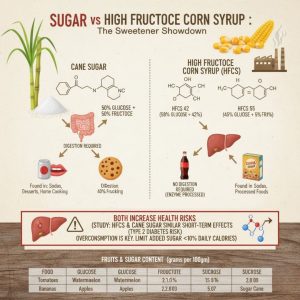
Lately there has been lot of talk about switching the sweetener in soft drinks from high fructose corn syrup to cane sugar. As I explained in one of my earlier posts that all sugars are “empty” calories with bad health effects. So why there is so much fuss about HFCS? Let’s first understand at a molecular level, what the differences are between sugar and HFCS. Sugar is extracted from cane sugar or sugar beets. Sugar is a combination of one glucose and one fructose molecule. When we add it to drinks or use in cooking, it is digested in our mouth and intestine to glucose and fructose. Glucose and fructose are absorbed and enter our body via liver. Glucose is the main energy source our body uses. Fructose is mostly converted to fat in our liver.
The HFCS was introduced by the food industry as a sweetener in 1980s. It is made from corn starch (a long chain of glucose molecules tied together) by using enzymes and results in HFCS containing different levels of glucose and fructose. According to Food and Drug Administration, HFCS 42 (42% fructose and 58% glucose) is primarily used in processed foods, whereas HFCS 55 (55% fructose and 45% glucose) is often found in sodas. Fructose is two times sweeter than sugar. In contrast to sugar, HFCS does not require our body to digest it as it has already been digested by enzymes during the manufacturing process. It comes as liquid containing 24% water, is cheaper than sugar and is easy to use in the food industry processes.
What are the bad health effects of over consumption of sugar and high fructose corn syrup (HFCS)?
One recent National Institutes of Health funded study (https://pmc.ncbi.nlm.nih.gov/articles/PMC8530743/), tested drinks sweetened with HFCS and cane sugar against aspartame-based sodas and found that both the HFCS and cane sugar increased fatty liver disease and decreased insulin sensitivity, a risk factor for Type 2 diabetes, with no significant differences between the two. It is not surprising as HFCS is 45% glucose and 55% fructose vs 50% glucose and 50% fructose for cane sugar. The study was only 16 days long and required subjects to drink 3 cans of a soft drink per day. A 12-ounce can of a soft drink contains 39gm of sugars from HFCS. It is likely that over years, the fatty liver disease may become worse in people on HFCS soda. The bottom line is both sugar and HFCS in high quantities are bad for our health. Fatty liver disease is very prevalent among Indian Americans. The Dietary Guidelines for Americans, 2020–2025, recommends <10% of calories per day from added sugar based on a 2000-calorie daily diet.
Although fruits contain many useful nutrients in addition to glucose, fructose and sucrose (table sugar), we should avoid over consumption of fruits high in fructose. The Table below gives grams of each sugar in 100gm of each fruit (from Canadian Sugar Institute website)
| Food | Glucose | Fructose | Sucrose |
|---|---|---|---|
| Tomatoes | 1.1 | 1.4 | 0 |
| Sweet Peas | 0 | 0 | 4.3 |
| Sweet Corn | 0.8 | 0.6 | 3.4 |
| Carrots | 1.0 | 1.0 | 3.6 |
| Peaches | 1.1 | 1.3 | 5.6 |
| Oranges | 2.2 | 2.5 | 4.2 |
| Watermelon | 1.6 | 3.3 | 3.6 |
| Pears | 1.9 | 6.4 | 1.8 |
| Canned Pears | 4.8 | 5.1 | 1.1 |
| Apples | 2.3 | 7.6 | 3.3 |
| Mangoes | 0.7 | 2.9 | 9.9 |
| Bananas | 4.2 | 2.7 | 6.5 |
| Sugar Beets | 0 | 0 | 18 |
| Sugar Cane | 2.27 | 0.55 | 10.03 |